
Quick decision: Match the mounting interface first, then measure the cross-section. Similar outer shapes are not evidence that two seals are interchangeable.
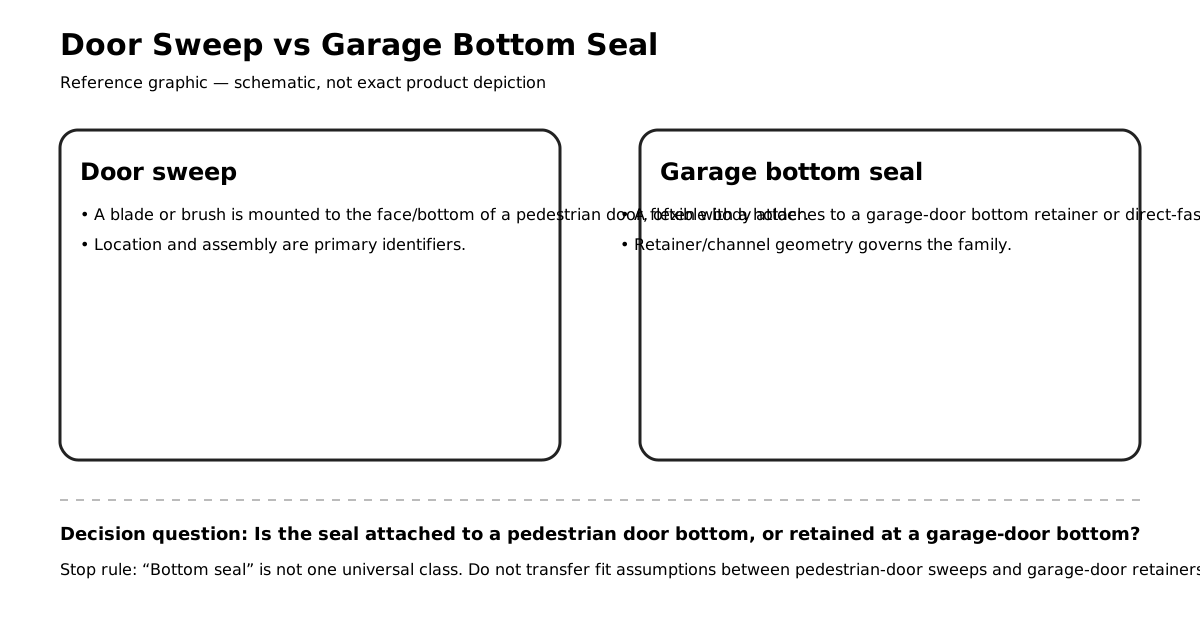
Decision question
Is the seal attached to a pedestrian door bottom, or retained at a garage-door bottom?
Door sweep
- A blade or brush is mounted to the face/bottom of a pedestrian door, often with a holder.
- Location and assembly are primary identifiers.
Measure or record:
- blade/brush projection
- holder geometry
- mount face
- door-bottom clearance
Garage bottom seal
- A flexible body attaches to a garage-door bottom retainer or direct-fastened bottom system.
- Retainer/channel geometry governs the family.
Measure or record:
- attachment geometry
- channel count
- spacing/base width
- body height
Stop rule
“Bottom seal” is not one universal class. Do not transfer fit assumptions between pedestrian-door sweeps and garage-door retainers.
Profiles to inspect next
- Flexible blade / fin sweep — interface: surface-mounted sweep holder or direct mount
- Brush sweep — interface: surface-mounted holder / retainer
- Double T-end with U/bulb body — interface: double-channel T-end retainer
- Single T-end bulb/body — interface: single-channel T-end retainer
- Stop-molding / doorstop flap — interface: nailed/screwed frame molding
- Floor-mounted threshold seal — interface: adhesive / floor mount
How to verify your sample
Use the measurement guide for the geometry you can observe. If the mounting interface or a critical dimension differs, treat the profiles as different and stop before making a fit claim. Exact compatibility needs separate product- or application-specific evidence.
Provenance
- Source — U.S. Department of Energy, Job Aid 11-1: Install Weatherstripping on an Exterior Door — https://www.energy.gov/cmei/scep/wap/articles/job-aid-11-1-install-weatherstripping-exterior-door — supports: Exterior-door weatherstripping and sweep are distinct but complementary components.
- Source — Pemko / ASSA ABLOY, 90062 Series Nylon Brush Gasket — https://www.pemko.com/en/products/brush-weatherstripping/product-details-nm.aehpdp-90062-series-ag_pemko_12054 — supports: Brush gasket used as a door-bottom sweep; holder/retainer plus brush is an assembly distinction.
- Source — Pemko / ASSA ABLOY, Everything You Wanted to Know About Pemko — https://www.pemko.com/content/pemko/us/en/resource-library/knowledge-center/blog/blog-post.aehdynamic-everything-you-wanted-to-know-about-pemko-636abfafabed64003d9ab061_pemko.html — supports: Door bottoms include sweeps, shoes and automatic door bottoms; brush-seal terminology.
- Source — Garaga, Garage Door Weather Stripping & Seals Made Easy — https://www.garaga.com/garage-door-parts/weatherstripping — supports: Garage perimeter/doorstop, threshold and inter-panel/joint-gasket distinctions.
- Source — Clopay, Glossary of Common Garage Door Terms & Definitions — https://www.clopaydoor.com/residential-garage-glossary — supports: Garage jamb seal, perimeter seal, stop molding/doorstop and astragal package terminology.
- Source — Action Industries, Vinyl T-End Bulb Weather Seals — https://action-ind.com/pro-t-style-vinyl-bulb-garage-door-bottom-seal/ — supports: Garage bottom T-end attachment terminology and separation of attachment end from bulb body.
- Source — Action Direct, Garage Door Bottom Seal Attachment Types: T-End, Bead-End, P-Bulb, & More — https://shopactiondirect.com/blog/garage-door-bottom-seal-attachment-types/ — supports: Trade terminology for T-end, bead-end, P-bulb, single/double-channel and specialty attachment profiles; treated as terminology evidence, not universal compatibility.
This comparison uses the cited public sources and keeps terminology, observed geometry and exact fit as separate claims. The included schematic is original and intentionally generic.