
Quick decision: Match the mounting interface first, then measure the cross-section. Similar outer shapes are not evidence that two seals are interchangeable.
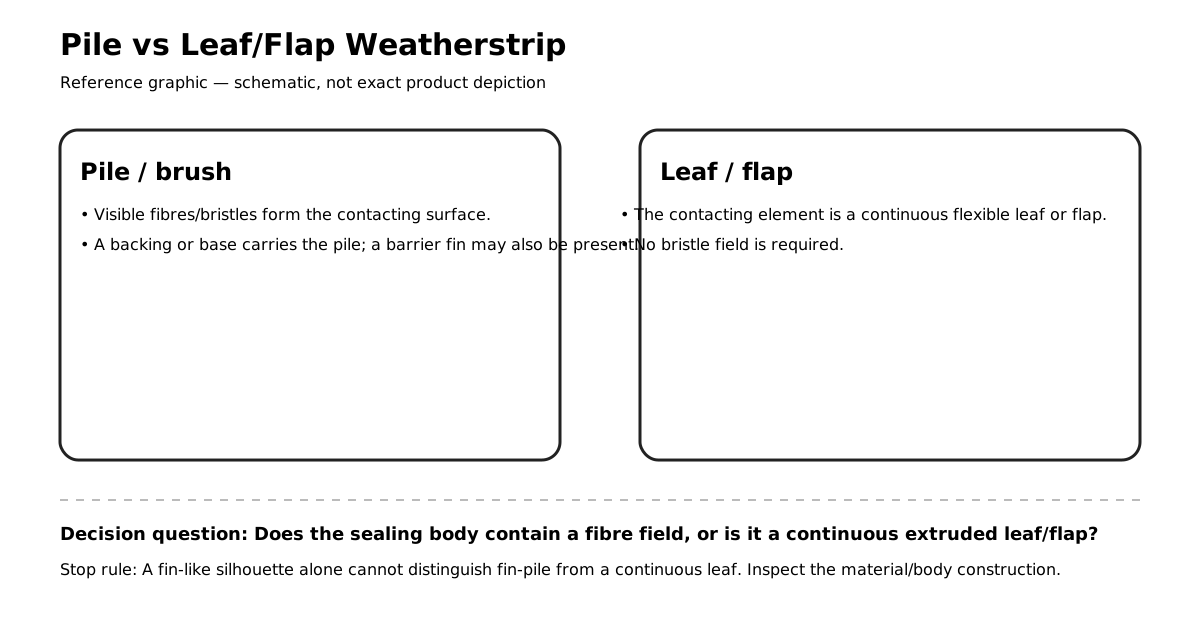
Decision question
Does the sealing body contain a fibre field, or is it a continuous extruded leaf/flap?
Pile / brush
- Visible fibres/bristles form the contacting surface.
- A backing or base carries the pile; a barrier fin may also be present.
Measure or record:
- backing/base width
- pile fibre height
- fin count/position if present
- mount interface
Leaf / flap
- The contacting element is a continuous flexible leaf or flap.
- No bristle field is required.
Measure or record:
- base width
- leaf reach
- overall height
- mount interface
Stop rule
A fin-like silhouette alone cannot distinguish fin-pile from a continuous leaf. Inspect the material/body construction.
Profiles to inspect next
- Woven pile — interface: woven backing / carrier
- Extruded-base pile — interface: rigid extruded base / carrier
- Single-fin pile — interface: woven or extruded base / carrier
- Multi-fin pile — interface: carrier / backing
- Kerf-mounted pile — interface: kerf / push-in backing
- Adhesive-backed pile — interface: pressure-sensitive adhesive
- Kerf-in leaf / flap — interface: kerf / inserted base
- T-slot leaf / flap extrusion — interface: T-slot / slide-in base
How to verify your sample
Use the measurement guide for the geometry you can observe. If the mounting interface or a critical dimension differs, treat the profiles as different and stop before making a fit claim. Exact compatibility needs separate product- or application-specific evidence.
Provenance
- Source — Maryland Energy Administration, Weatherstripping — https://energy.maryland.gov/residential/pages/technicalassistance/weatherstripping.aspx — supports: Generic tension/V-strip, felt, pile, foam tape, reinforced foam, tubular gasket and door-seal terminology; application distinctions.
- Source — Schlegel, Weatherseal products: Q-LON, pile & extruded seals — https://www.schlegel.com/products/ — supports: Compression foam gasket, brush pile, fin-pile, extruded-seal technologies; kerf/surface/carrier fitment distinctions.
- Source — Schlegel, Brush pile seals for windows, doors & shutters — https://www.schlegel.com/products/brush-pile-seals/ — supports: Woven vs extruded pile, optional fins, adhesive backing, sliding window/door applications.
- Source — Ultrafab, Custom Plastic Extrusions | Profiles & Seals — https://www.ultrafab.com/product/custom-extrusions/ — supports: Distinct profile/interface labels including T-slot, kerf-mounted, leaf and multi-hollow bulb.
- Source — Ultrafab, Extruded Leaf & Flap Seals — https://www.ultrafab.com/product/extruded-leaf-flap-seals/ — supports: Leaf/flap as a legitimate extruded weatherseal profile family for window/door compression/sliding contexts.
- Source — Ultrafab, Pile Weatherstripping and Weatherseals for Windows & Doors — https://www.ultrafab.com/pile-weatherseals/ — supports: Pile, fin-pile, kerf-mounted pile and adhesive-backed pile categories.
This comparison uses the cited public sources and keeps terminology, observed geometry and exact fit as separate claims. The included schematic is original and intentionally generic.