Weatherstrip Reference
Measure Garage Door Bottom Retainers
Use this workflow for garage-door bottom retainer inserts. Count and inspect attachment channels first, then capture attachment-end geometry and body dimensions without assuming a brand or door model.
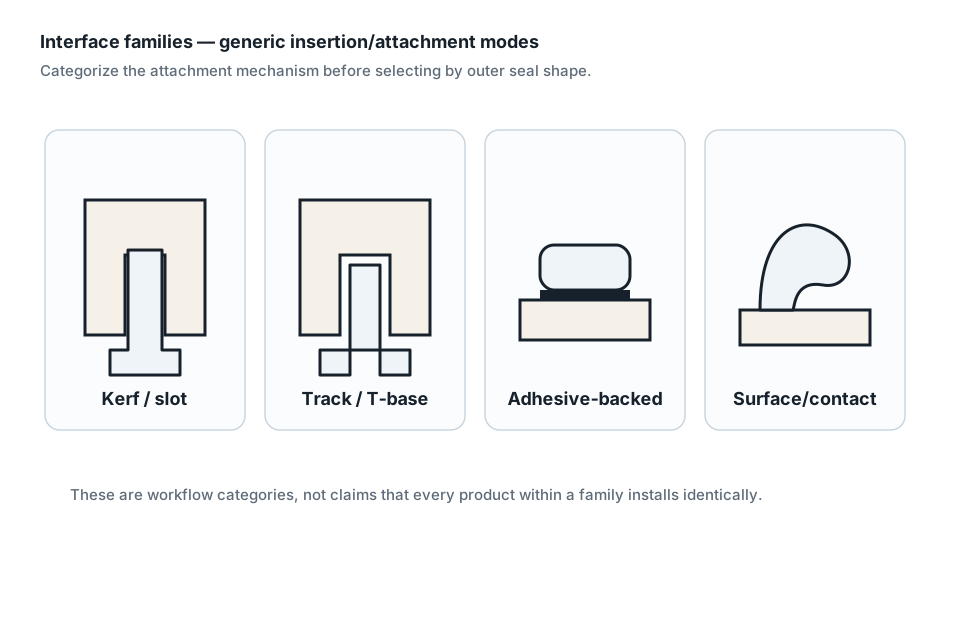
Family coverage
| Family | Subtype | Evidence | Mount/interface | Source scope |
|---|---|---|---|---|
profile record | Double T-end with U/bulb body | Source-backed | double-channel T-end retainer | See source notes on this page |
profile record | Single T-end bulb/body | Source-backed | single-channel T-end retainer | See source notes on this page |
profile record | Bead-end attachment | partial | bead / rounded attachment in retainer channel | See source notes on this page |
profile record | P-bulb / P-style profile | partial | profile-specific retainer attachment | See source notes on this page |
profile record | Specialty / proprietary attachment | partial | non-generic / specialty retainer | See source notes on this page |
Measurement fields
| What to record | When needed | Unit or choices | Definition | Quality rule |
|---|---|---|---|---|
| Evidence confidence | yes | source-backed, partial, unverified | State of measurement evidence, not replacement fit. | Source-backed evidence requires direct measurements/photos or authoritative dimensional source. |
| Observed profile family | yes | pile, bulb_tube, flipper_leaf_v, foam_tape, sweep_brush, hybrid, unknown | Observed geometry family only. | Do not force a family if ambiguous. |
| Observed mounting interface | yes | t_slot, kerf_stem, adhesive, clip_channel, surface_fastened, integral_extrusion, unknown | How the seal is retained or mounted. | Observed only. |
| Sample condition | yes | new, used_good, used_worn, compressed_set, torn, deformed, unknown | Condition of measured sample. | Worn/deformed samples lower confidence. |
| Measurement tool | yes | Caliper/ruler/gauge used. | Record exact tool type; no assumed resolution. | |
| Tool resolution | yes | mm | Smallest readable increment. | Do not report more precision than instrument supports. |
| Repeat readings | yes | count | Number of readings per critical dimension. | Target 3 when practical. |
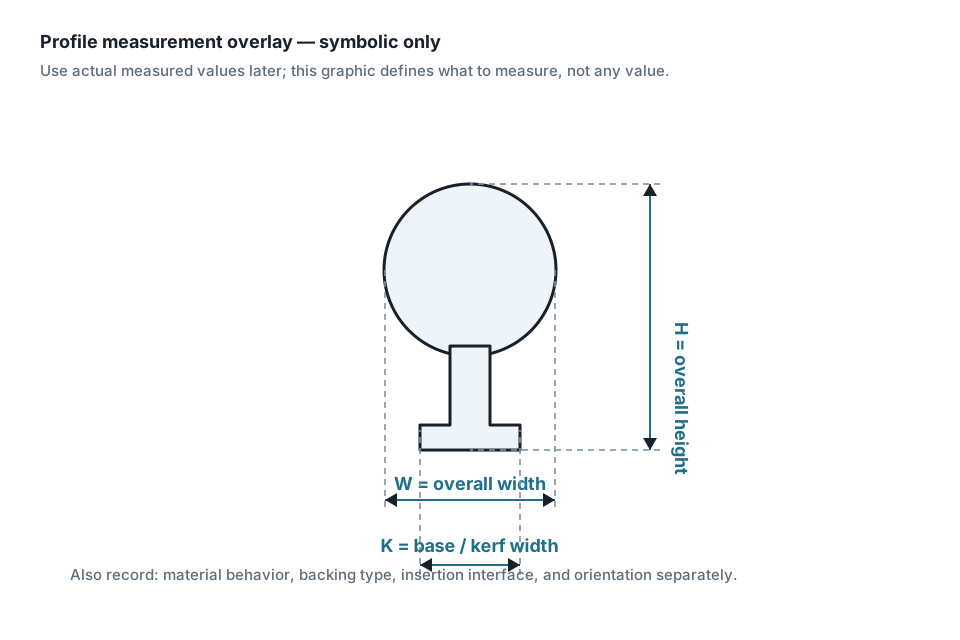
| Base/backing width | conditional | mm | Maximum overall width of backing/base perpendicular to strip length. | Measure relaxed; do not crush flexible base. |
| overall profile height | yes | mm | Bottom of mounting/base datum to furthest relaxed sealing tip. | Store separately from vendor-specific 'pile height' terminology. |
| bulb body width | conditional | mm | Maximum relaxed body width in cross-section. | Preferred for non-circular bulbs. |
| Bulb body height | conditional | mm | Relaxed body height normal to mounting datum. | Preferred for non-circular bulbs. |
| channel throat width | conditional | mm | Narrow visible opening between retaining lips. | Measure channel, not the removed backing. |
| channel cavity width | optional | mm | Internal cavity width behind throat, if directly accessible. | leave blank / unmeasured if not safely accessible. |
| channel depth | conditional | mm | Depth from opening datum to cavity/kerf floor. | Direct measurement only. |
| uncompressed sealing projection | conditional | mm | Projection from mounting datum to relaxed sealing tip. | Can equal overall height only when datum is same. |
| Contact motion | yes | normal_compression, lateral_wipe, sliding_brush_contact, hybrid, none, unknown | How mating surface approaches/acts on seal. | Observed from installation context. |
| Compression/contact direction | yes | Plain-language direction relative to mounting surface and closure motion. | Example: 'door closes normal to bulb; bulb compresses toward jamb'. | |
| Insertion direction | conditional | Direction seal inserts/slides/snaps into channel. | Record only if observed. | |
| Observed material class | yes | pile_fiber, solid_elastomer, cellular_foam, plastic_leaf, coextruded, mixed, unknown | Observed material class only. | Specific polymer only if marked or source-backed. |
| Original reported value | yes | Original user/source value and unit before conversion. | Preserve provenance and rounding. | |
| Measurement notes | yes | Range, repeated readings, deformation, ambiguity, inaccessible dimensions. | Mandatory when any critical field is missing/uncertain. |
Protocol
- Stabilize sample: Remove only if safe; let flexible profile relax without stretching or intentional compression. If installed-only, document that limitation.
- Choose datum: Orient cross-section with mounting/base datum at bottom and active sealing element toward top/contact surface. Record orientation.
- Record tool/resolution: Log instrument and actual resolution before dimensions. Canonical numeric storage is mm; retain original unit text.
- Take repeat readings: Take 3 readings at separated, representative points when practical. Store median plus range in notes; do not average across visibly different wear zones.
- Measure base/interface first: Measure backing/base width/thickness or kerf stem before soft sealing element so retention geometry is not conflated with seal projection.
- Measure relaxed sealing geometry: Use minimum pressure. For pile, measure fiber-only height from top of backing and also overall profile height. For irregular bulbs store width and height instead of a false diameter.
- Measure receiving channel separately: If accessible without damage, measure throat width, cavity width and depth. Never substitute backing width for channel throat width.
- Capture contact mechanics: Record closure/contact motion: normal compression, lateral wipe, sliding brush contact, hybrid or unknown. Add plain-language direction.
- Capture material conservatively: Record observable class only. Specific polymer/material name requires marking, packaging, authoritative source or instrumented verification.
- Photograph evidence: Complete V01-V04 and V08; add V05-V07/V09 when applicable. Scale must be in same plane for dimensional reference.
- Apply uncertainty state: Source-backed only for directly measured/authoritatively sourced fields; partial when core evidence is incomplete; unverified when identity/geometry depends on guesswork.
- No fit decision: This standard may narrow site geometry but must not assert replacement compatibility, generation equivalence or acceptable compression without separate source-backed fit evidence.
Route-specific cautions
- Record channel count, T-end/bead/specialty attachment geometry and end-to-end spacing in measurement_notes because Reference v1 has no dedicated fields for these garage-specific observations.
- Do not substitute backing width for retainer throat width, and do not infer single- vs double-channel interchangeability.
Blank capture table
| Observation | Raw value + unit | Normalized value | Repeat/range | Evidence | Notes |
|---|---|---|---|---|---|
| Mount/interface | |||||
| Base/attachment geometry | |||||
| Overall relaxed profile height | |||||
| Sealing-body geometry | |||||
| Receiver/channel geometry |
Stop before fit: measurements can narrow site geometry but do not prove replacement compatibility. Keep incomplete or conflicting records partial/unverified.
Related canonical routes
Provenance
Primary internal evidence: Reference measurement schema/protocol, Reference evidence rules, Weatherstrip the route registry, and Reference family definitions. No source scope is upgraded by Reference.
- Source — Action Industries, Vinyl T-End Bulb Weather Seals
https://action-ind.com/pro-t-style-vinyl-bulb-garage-door-bottom-seal/
Supports: Garage bottom T-end attachment terminology and separation of attachment end from bulb body. · accessed 2026-10-07 - Source — Action Direct, Garage Door Bottom Seal Attachment Types: T-End, Bead-End, P-Bulb, & More
https://shopactiondirect.com/blog/garage-door-bottom-seal-attachment-types/
Supports: Trade terminology for T-end, bead-end, P-bulb, single/double-channel and specialty attachment profiles; treated as terminology evidence, not universal compatibility. · accessed 2026-10-07