Technical record details
Canonical route: /profiles/blade-door-sweep/ · Generic family evidence: source-backed · Exact product fit: not evaluated.
What this profile class means
Profile family: Door bottom
Profile subtype: Flexible blade / fin sweep
Common application context: door
Contact mode: wiping / compression at floor
Seal body: flexible blade or fin
Mounting interface: surface-mounted sweep holder or direct mount
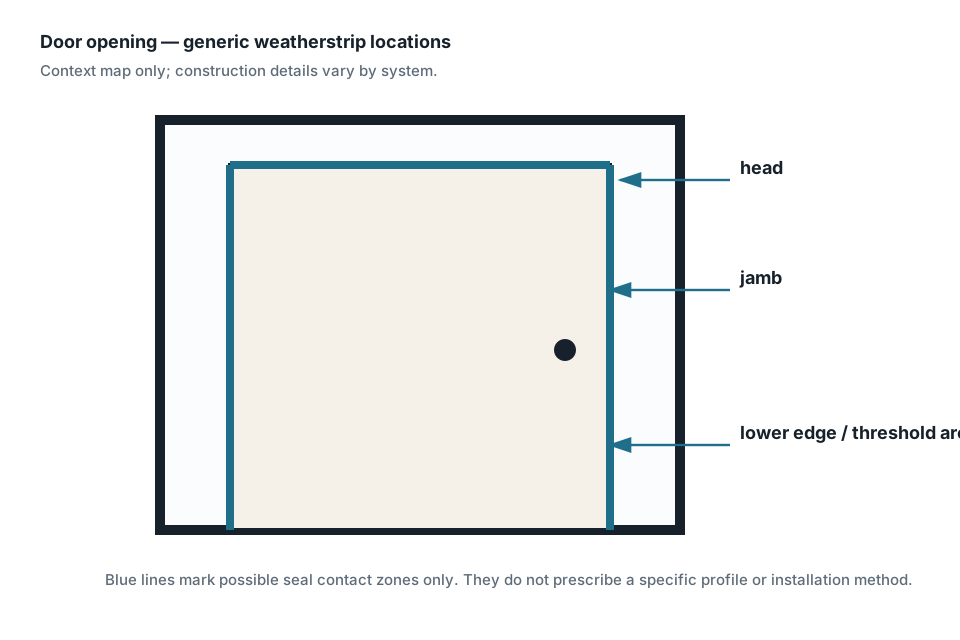
A flexible blade projects below the door and contacts threshold/floor.
Common terminology that may lead to this class includes: door sweep, rubber sweep, vinyl sweep, blade sweep. These terms are discovery clues only; they do not prove fit.
Identification order
- Confirm the installed location and motion: pedestrian exterior/interior door bottom.
- Identify the mounting/receiver interface before judging the outer body shape.
- Inspect an end-view cross-section and note orientation, mirrored/asymmetric features, fibres, chambers, leaves/flaps, carriers, or fasteners as applicable.
- Measure the critical fields below using the the measurement datum and tool-resolution rules and preserve uncertainty.
- Compare only against records with compatible interface geometry. Treat visual similarity as a clue, not as compatibility evidence.
- Keep product identity and replacement fit as separate claims under this evidence policy.
What to measure
blade projection— capture as an observed/measured field; do not invent a value.holder height— capture as an observed/measured field; do not invent a value.mount face— capture as an observed/measured field; do not invent a value.door bottom clearance— capture as an observed/measured field; do not invent a value.
Also record the measurement tool, resolution, repeated readings where practical, sample condition, original reported value/unit, and measurement notes. If a critical field cannot be measured safely or reliably, leave it UNMEASURED rather than guessing.
What not to infer
Do not infer threshold compatibility, fire/smoke rating or gap capacity from 'sweep'.
Additional guardrails:
- Do not infer brand/model compatibility from a family name or silhouette.
- Do not infer a universal dimension from terms such as “kerf,” “T-slot,” “pile,” “bulb,” “sweep,” or “felt.”
- Do not infer material composition unless it is marked, directly observed at the generic class level, or source-backed.
- Do not publish a fit/supersession statement without explicit authoritative evidence for that relationship.
Evidence and provenance
This page uses source-backed profile taxonomy, measurement rules and evidence boundaries. The site structure does not broaden the scope of the cited sources or establish exact replacement fit.
- Source — U.S. Department of Energy, Job Aid 11-1: Install Weatherstripping on an Exterior Door — https://www.energy.gov/cmei/scep/wap/articles/job-aid-11-1-install-weatherstripping-exterior-door — supports: Exterior-door weatherstripping and sweep are distinct but complementary components.
- Source — Pemko / ASSA ABLOY, Everything You Wanted to Know About Pemko — https://www.pemko.com/content/pemko/us/en/resource-library/knowledge-center/blog/blog-post.aehdynamic-everything-you-wanted-to-know-about-pemko-636abfafabed64003d9ab061_pemko.html — supports: Door bottoms include sweeps, shoes and automatic door bottoms; brush-seal terminology.
Useful next steps
- Door Bottom Seals, Sweeps & Shoes — Profile family
- Measure Door Bottom Seals & Sweeps — Measurement guide
- Door Weatherstrip Identification — Application guide
- Weatherstrip Terminology Guide — Terminology guide
- Weatherstrip Identification Methodology — Methodology
Integration note
Use the Weatherstrip Reference exactly as written. Do not create an alias page for the common terms above. Any original illustration used on this route must remain labelled “Reference graphic — schematic, not exact product depiction” unless a later exact record binds geometry to evidence.