About this profile guide
This page describes a generic profile family supported by cited sources. Exact product fit has not been evaluated.
What this profile class means
Profile family: Compression seal
Profile subtype: T-slot leaf / flap extrusion
Common application context: window, door
Contact mode: compression or wiping contact
Seal body: leaf / flap
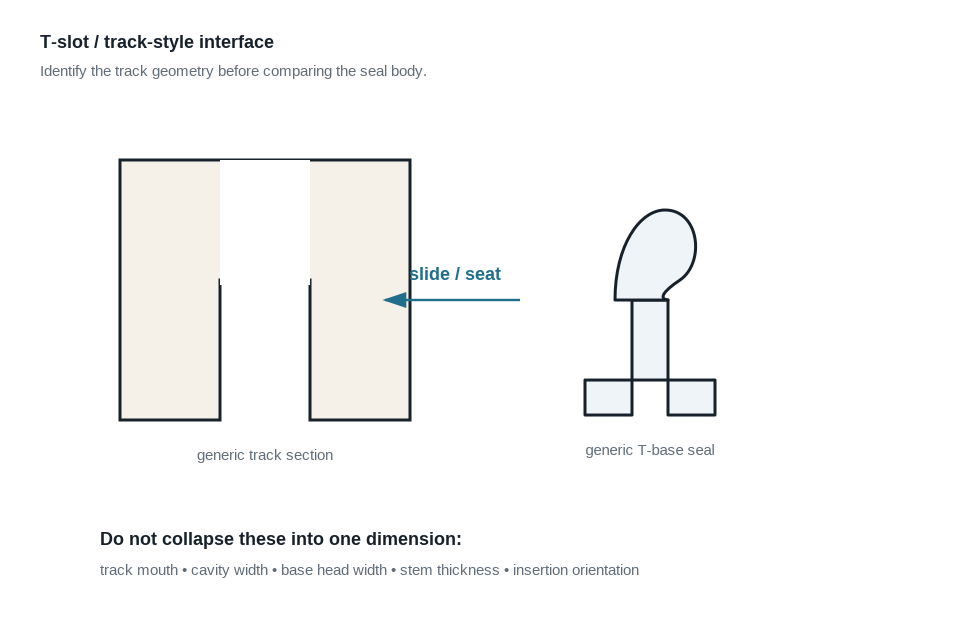
Mounting interface: T-slot / slide-in base
Continuous leaf/flap body with a slide-in base for an extruded slot.
Common terminology that may lead to this class includes: T-slot leaf seal, T-slot flap seal, T-slot wiper. These terms are discovery clues only; they do not prove fit.
Identification order
- Confirm the installed location and motion: window/door sash and frame sealing.
- Identify the mounting/receiver interface before judging the outer body shape.
- Inspect an end-view cross-section and note orientation, mirrored/asymmetric features, fibres, chambers, leaves/flaps, carriers, or fasteners as applicable.
- Measure the features listed below from consistent reference points. Note your measuring tool and its precision, and flag anything you cannot confirm.
- Compare the mounting interface and dimensions of possible replacements with the existing seal. A similar appearance alone does not confirm fit.
- A matching product name or appearance does not prove replacement fit. Check the specific product information and the measurements of the installed seal.
What to measure
T-base width— observe or measure this on the existing seal; if you cannot check it reliably, leave it unknown.neck width— observe or measure this on the existing seal; if you cannot check it reliably, leave it unknown.leaf reach— observe or measure this on the existing seal; if you cannot check it reliably, leave it unknown.overall height— observe or measure this on the existing seal; if you cannot check it reliably, leave it unknown.orientation— observe or measure this on the existing seal; if you cannot check it reliably, leave it unknown.
Note which measuring tool you used, its precision, any repeat readings, the condition of the seal, and the units. If something cannot be checked safely or reliably, leave it unknown rather than guessing.
What not to infer
Do not assume slot size from family name; base dimensions are mandatory for fit work.
Additional guardrails:
- Do not infer brand/model compatibility from a family name or silhouette.
- Do not infer a universal dimension from terms such as “kerf,” “T-slot,” “pile,” “bulb,” “sweep,” or “felt.”
- Do not assume what a seal is made of from its shape alone; check a label or reliable manufacturer information.
Evidence and provenance
The sources below describe general profile shapes and measurement methods. They do not establish that a particular replacement fits an individual installation.
- Source — Ultrafab, Custom Plastic Extrusions | Profiles & Seals — https://www.ultrafab.com/product/custom-extrusions/ — supports: Distinct profile/interface labels including T-slot, kerf-mounted, leaf and multi-hollow bulb.
- Source — Ultrafab, Extruded Leaf & Flap Seals — https://www.ultrafab.com/product/extruded-leaf-flap-seals/ — supports: Leaf/flap as a legitimate extruded weatherseal profile family for window/door compression/sliding contexts.
Useful next steps
- Compression Weatherstrip Profiles — Profile family
- Measure Leaf & Flap Weatherstrip — Measurement guide
- Window Weatherstrip Identification — Application guide
- Door Weatherstrip Identification — Application guide
- Weatherstrip Terminology Guide — Terminology guide
- Weatherstrip Identification Methodology — Methodology