Double T-end with U/bulb body Weatherstrip Profile
Two T-shaped attachment edges feed into parallel retainer channels; flexible middle body forms the floor-contact seal. This page identifies a generic family and the measurements needed to compare sites; it does not identify an exact replacement.
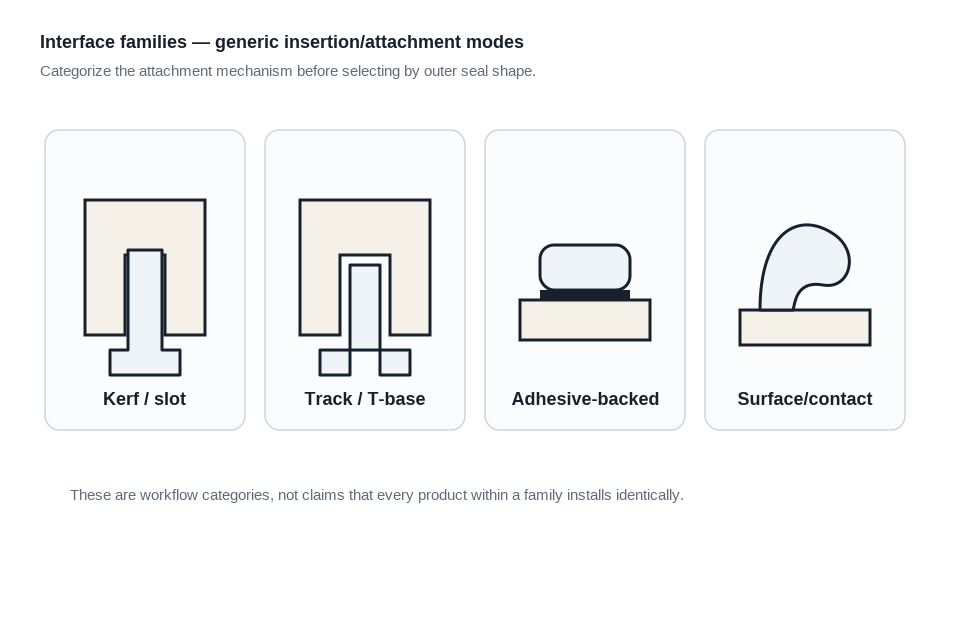
How to recognise the attachment
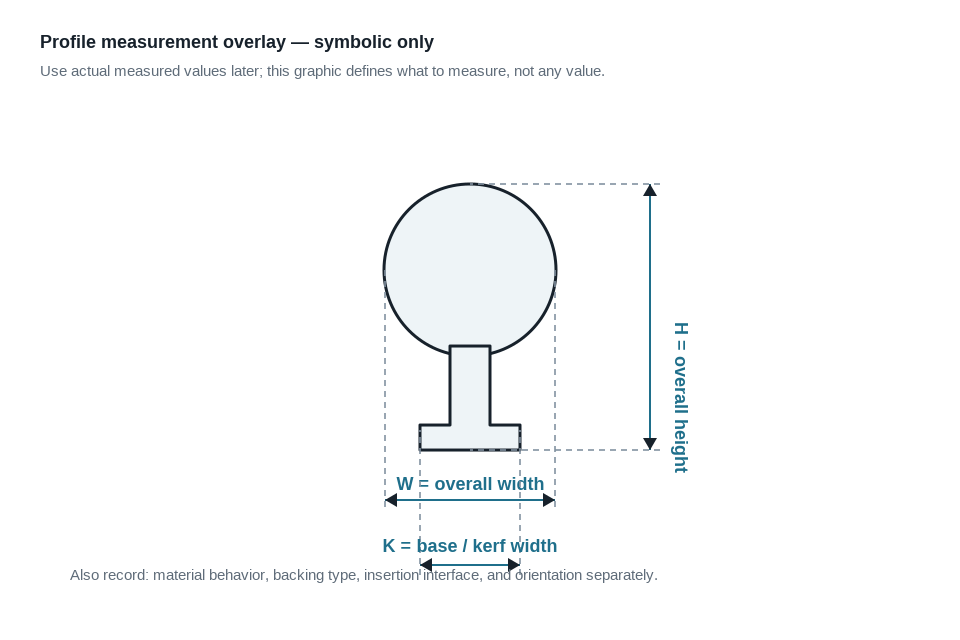
A double T-end loop has a retained T-shaped foot on each edge. Measure both feet and the spacing between the two channels. Record the flat width of the flexible body separately. If only one edge is retained, check the single T-end profile. See how to measure the retainer.
Identification snapshot
- Subtype
- Double T-end with U/bulb body
- Contact mode
- compression at floor
- Seal body
- U/bulb/flexible sheet body
- Mount/interface
- double-channel T-end retainer
- Common terms
- T-end U seal, double-T bottom seal, T-style garage bottom seal
- Typical intent
- sectional garage door bottom
Measure before comparing
| Measurement / observation | What to record | Capture rule |
|---|---|---|
| T-end geometry | Describe the shape of each T-shaped attachment edge and photograph a clear end view. | Measure directly when possible; preserve original value/unit and uncertainty. |
| end-to-end spacing | Measure the spacing between the two T-shaped attachment edges on the relaxed strip. | Measure directly when possible; preserve original value/unit and uncertainty. |
| channel count | Count the separate channels in the installed retainer; do not assume two if one is obscured. | Measure directly when possible; preserve original value/unit and uncertainty. |
| laid-flat width | Measure the relaxed seal width when laid flat without stretching it. | Measure directly when possible; preserve original value/unit and uncertainty. |
| body height | overall profile height | Measure directly when possible; preserve original value/unit and uncertainty. |
Measurement workflow
- Stabilize the sample without stretching or deliberate compression.
- Choose and record the mounting/base datum.
- Record the tool and actual resolution before dimensions.
- Measure the base/interface before the soft sealing element.
- Capture relaxed geometry with minimal pressure.
- Measure the receiver separately when accessible.
- Record contact motion, insertion/compression direction, sample condition and uncertainty.
- Keep compatibility separate: geometry may narrow sites but does not prove fit.
Provenance
Source-backed evidence only. This page does not broaden the scope of the cited sources.
- Source — Action Industries, Vinyl T-End Bulb Weather Seals
https://action-ind.com/pro-t-style-vinyl-bulb-garage-door-bottom-seal/
Supports: Garage bottom T-end attachment terminology and separation of attachment end from bulb body. · accessed 2026-10-07 - Source — Action Direct, Garage Door Bottom Seal Attachment Types: T-End, Bead-End, P-Bulb, & More
https://shopactiondirect.com/blog/garage-door-bottom-seal-attachment-types/
Supports: Trade terminology for T-end, bead-end, P-bulb, single/double-channel and specialty attachment profiles; treated as terminology evidence, not universal compatibility. · accessed 2026-10-07
Scope rule: Measurements, generic profile identification and exact replacement fit are kept separate. Use cited sources and your receiver geometry before making a fit decision.
Useful next steps
- Garage Door Seal Profile Families — Profile family
- Measure Garage Door Bottom Retainers — Measurement guide
- Garage Door Weatherstrip Profiles — Application guide
- Weatherstrip Terminology Guide — Terminology guide
- Methodology — Methodology