How to Identify and Measure a Garage Door Bottom Seal
Look at the bottom edge of the door from the end. A slide-in seal has one or more edges that sit in a track, also called a retainer. Check whether those edges are T-shaped or rounded like beads. If screws or fasteners hold the seal directly to the door, use the fastener pattern to identify it.
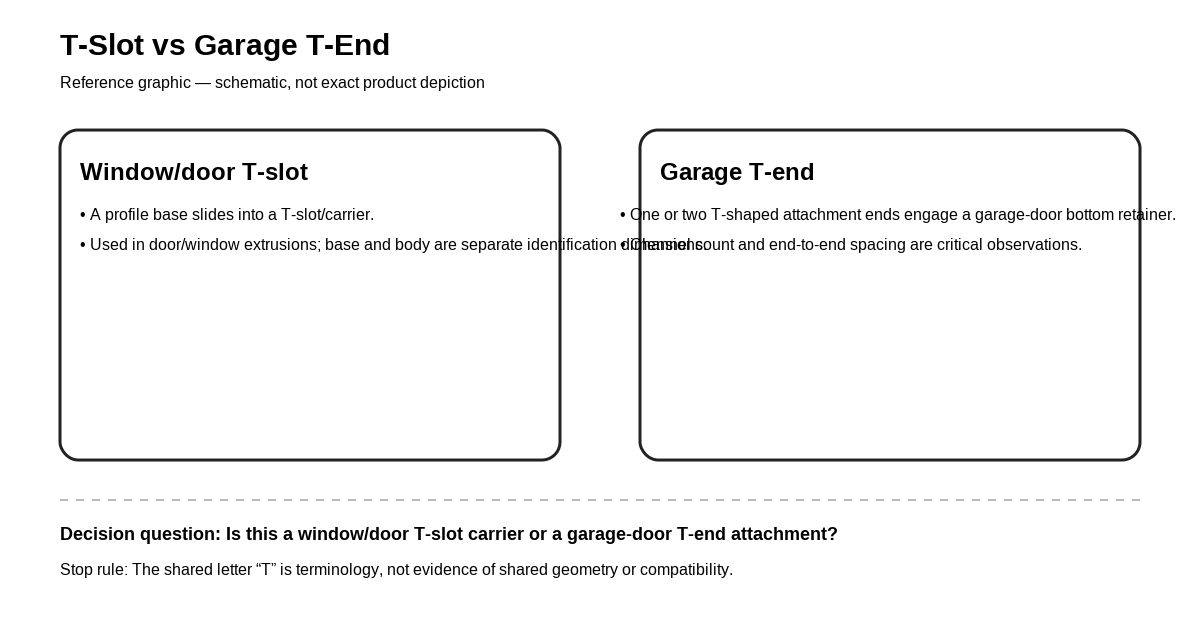
Match the attachment style
| What you see | What to record | Guide |
|---|---|---|
| Flat T-shaped edge in one or two channels | Channel count, track opening, and width of each T-head. | Single T-end or double T-end |
| Rounded bead that slides into a groove | Groove opening and bead shape and diameter from an undamaged section. | Measure the bottom retainer |
| Fasteners through a flange attached to the door | Flange width, fastener locations and spacing, and the surface it attaches to. | Measure a direct-fastened seal |
Identify the edge that holds the seal
Look at the end of the seal beside the holder. A flat cap across a narrow stem identifies a T-end. A round or nearly round attachment identifies a bead-end. A U-shaped loop or bulb describes the flexible body, so two similar-looking seals can have different attachment edges.
Count the channels in the retainer at the bottom of the door. A single T-end uses one retained edge, while a double T-end loop uses two. Photograph the seal edge and retainer end together before comparing dimensions.
Garaga Canada documents one-piece and two-piece bottom weatherstripping configurations, including PVC and aluminum bases. First check whether the insert is a separate part. Match the full door model and receiver before using a manufacturer replacement listing.
Take these measurements before ordering
- With the door stationary, photograph an accessible end of the retainer and seal beside a ruler. Leave the door hardware in place.
- For a slide-in seal, record each slot opening and the attachment edge it holds. For two channels, also measure the spacing between them. Record the values in inches or millimeters and keep the unit with each measurement.
- Record the required seal length and check the floor gap at the left, center and right with the door closed. If the old seal is distorted, use the track measurements and manufacturer diagram to confirm the attachment.
Before you buy: Match the measurements to the replacement drawing or a manufacturer-confirmed part for your door. A matching seal shape is only the first check. If the strip is fixed to the floor, see the garage floor threshold guide.
For manufacturer examples of the different seal locations, see the Clopay garage door seal guide.